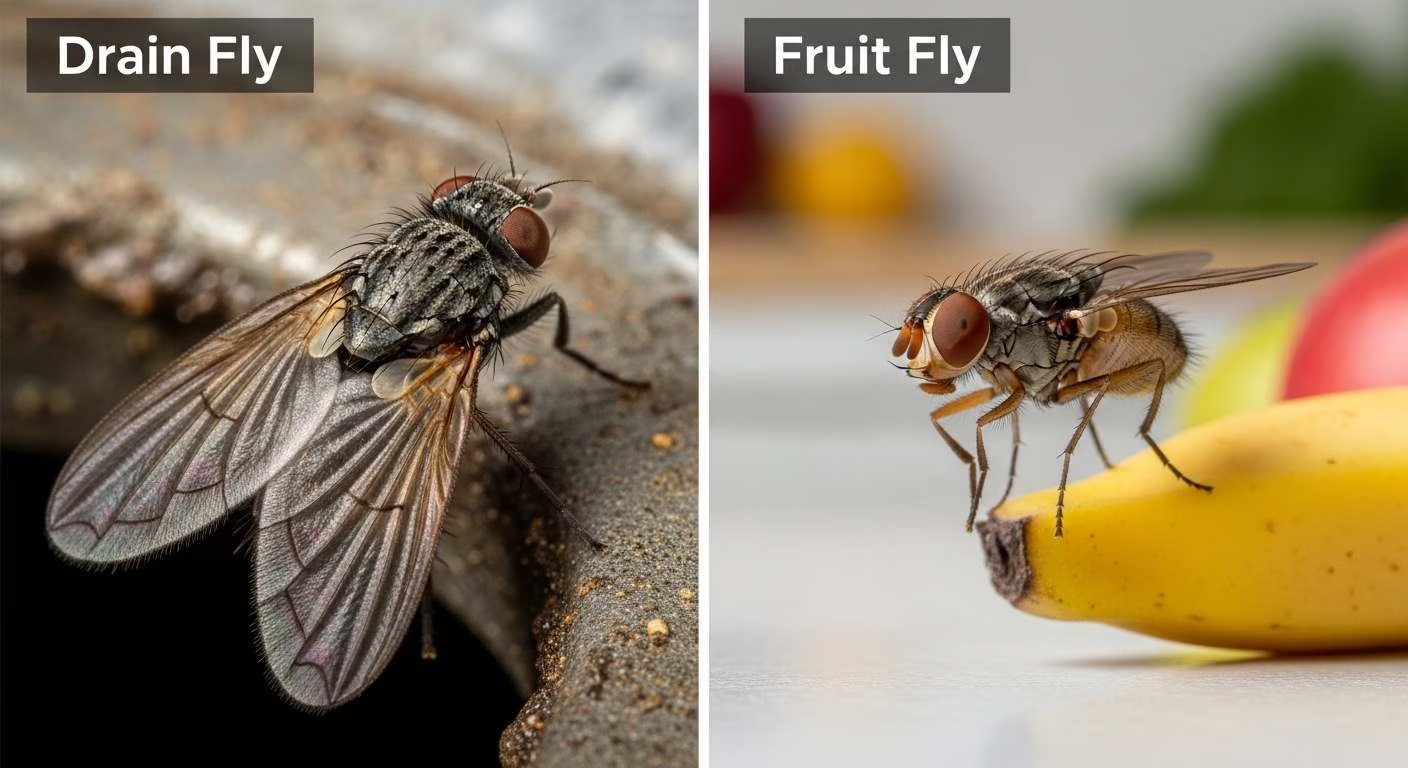
Quick Answer: “The main difference between drain flies and fruit flies is their appearance and preferred breeding environment. Drain flies have fuzzy, moth-like wings and often gather near bathroom or kitchen drains. Fruit flies have smoother bodies, clear wings, and usually appear around overripe fruit or fermenting food waste. Both are small, but checking their wings, body shape, and nearby breeding sources can help you identify which pest is inside your home.”
Finding tiny flies in your kitchen or bathroom can be frustrating, especially when they keep appearing after you’ve cleaned everything. One day, you notice a few near the sink. A week later, they’re on the walls, around the trash can, or hovering over your fruit bowl.
The tricky part? Not every small fly in your home is the same insect.
When comparing drain flies vs fruit flies, the differences go beyond where you see them. Their body features, breeding habits, and life cycles can tell you a lot about what’s attracting them indoors.
Identifying the right insect matters because a treatment that works for fruit flies may do very little against drain flies. Here’s how to tell them apart and figure out where they’re coming from.
Drain Flies vs Fruit Flies: At-a-Glance Comparison
You don’t need to be an insect expert to spot the differences. A close look at the fly and the area where it appears will usually give you a good starting point.
| Feature | Drain Flies | Fruit Flies |
|---|---|---|
| Appearance | Fuzzy, moth-like body | Smooth, compact fly-like body |
| Wings | Broad, hairy, often held roof-like | Clear, narrow, without the fuzzy appearance |
| Color and eyes | Usually gray, brown, or black | Often tan or brown, with red or dark eyes |
| Adult size | Roughly 2–5 mm, depending on species | Usually 2–4 mm |
| Breeding sites | Organic film in drains and other damp locations | Fermenting fruit, vegetables, spills, and food waste |
| Flight behavior | Weak, short flights; often resting on walls | More active around food and fermenting liquids |
| Best control approach | Remove organic film and moisture problems | Remove fermenting food sources and clean contaminated areas |
The easiest clue: A tiny fly that resembles a miniature moth is more likely to be a drain fly. A smooth-bodied fly hovering around ripe bananas is more likely to be a fruit fly.
However, location alone isn’t enough for a certain identification. Some fruit flies can also develop in dirty drains containing fermenting material.
What Are Drain Flies?
Drain flies belong to the insect family Psychodidae. They’re also known as moth flies, filter flies, and sometimes sewer flies.
Their fuzzy appearance makes them relatively easy to recognize once you get a close look. Unlike many other household flies, they tend to rest on nearby walls and make short flights when disturbed.
Drain flies are commonly associated with damp areas containing decomposing organic material. In homes, that often means the slimy buildup inside sink drains, shower drains, floor drains, and plumbing traps.
That buildup is called biofilm, a community of microorganisms attached to a surface within a protective layer of organic material. It provides food and a suitable development site for drain fly larvae.
According to the University of Maryland Extension’s drain fly guidance, adult drain flies range from approximately 1/16 to 1/4 inch in length. Their development from egg to adult may take 7–28 days, depending on environmental conditions.
Once breeding is established, new adults can emerge regularly, which helps explain why simply removing the flies you see rarely solves the problem.
Drain flies can also breed outside ordinary sink drains. Wet garbage containers, condensate pans, sewer leaks, and other areas containing persistent moisture and organic debris may support their development.
What Are Fruit Flies?
Fruit flies belong to the family Drosophilidae. The common fruit fly, Drosophila melanogaster, is particularly well known because scientists have studied it extensively in genetics research.
Inside a home, these insects are most often associated with fermenting foods and liquids.
A bowl of bananas left on the counter, a forgotten onion in the pantry, or residue inside an empty soda bottle can attract fruit flies. The insects are especially drawn to the odors associated with fermentation.
Adult fruit flies generally have compact bodies, clear wings, and tan-to-brown coloring. Many have reddish eyes, although eye color varies among species.
Their rapid development makes them troublesome indoors.
Texas A&M AgriLife Extension reports that fruit flies can complete their life cycle in as little as eight days under favorable conditions. That’s a major reason why a handful of flies can quickly become a noticeable kitchen problem.
Fruit flies may also develop in damp food debris, recycling containers, dirty cleaning tools, and drains where suitable fermenting material has accumulated.
7 Key Differences Between Drain Flies and Fruit Flies
Although these insects share some habits, their physical characteristics and breeding preferences make them distinct.
1. Body Shape and Appearance
The first difference becomes obvious when you look closely at a resting adult.
Drain flies have rounded, fuzzy-looking bodies. Their hairy wings create a soft outline that resembles a tiny moth. You may notice this shape when one rests against a light-colored bathroom wall.
Fruit flies have a more familiar fly-like appearance. Their bodies are compact and smoother, without the dense hair that gives drain flies their fuzzy look.
If you’re unsure, take a close-up picture of the insect while it’s resting. Zooming in can make the body shape easier to compare.
2. Wing Texture and Position
Wing structure is one of the most useful features when comparing drain flies vs fruit flies.
Drain flies have broad wings covered with fine hairs. When resting, they often hold their wings in a roof-like position over the body, although some species hold them flatter.
Fruit flies have clearer, narrower wings that lack the obvious fuzzy covering.
Try observing the insect from above or slightly from the side. A moth-like wing outline points toward a drain fly, while transparent wings and a smooth body are more characteristic of fruit flies.
3. Color and Eye Features
Drain flies are generally gray, brownish-gray, or dark-colored. Their dense hairs can make the entire insect look dusty or velvety.
Fruit flies are commonly tan, yellowish-brown, or darker brown.
Many familiar fruit fly species have bright red eyes, making them easier to recognize in a close-up photo. However, not all fruit flies have red eyes. Dark-eyed fruit flies also exist.
Don’t rely on eye color alone. Body shape, wings, and breeding location provide a more dependable combination of clues.
4. Size
Both insects are small enough to be mistaken for specks moving around a countertop.
Adult drain flies commonly fall within a range of roughly 2–5 millimeters, although measurements vary by species.
Common household fruit flies are usually around 2–4 millimeters long.
Because their size ranges overlap, it’s difficult to distinguish them accurately by length alone.
A slightly larger insect isn’t automatically a drain fly, and a smaller insect isn’t necessarily a fruit fly.
If you can, compare the shape of the wings rather than trying to estimate a difference of one or two millimeters.
5. Breeding and Feeding Sites
This is where the distinction becomes especially useful for homeowners.
Drain fly larvae typically develop in moist organic films. Their common breeding sites include:
-
Sink and shower drains with accumulated organic film
-
Basement and laundry room floor drains
-
Areas affected by plumbing leaks
-
Dirty condensate pans
-
Other persistently damp locations containing decaying material
Fruit fly larvae generally develop where fermenting organic material is available. Common sources include:
-
Overripe or damaged fruit
-
Rotting potatoes and onions
-
Residue in bottles or recycling bins
-
Spilled juice, beer, or wine
-
Damp mops and garbage containers containing food waste
There’s an important overlap: some fruit flies can breed in drains when the conditions are suitable.
Penn State Extension’s household pest identification information identifies fermenting material in drains, garbage disposals, and trash containers as potential fruit fly breeding locations.
That means a fly emerging near a kitchen drain shouldn’t automatically be classified as a drain fly.
6. Flying Behavior
Drain flies aren’t particularly strong fliers. They often make short, irregular flights and quickly settle on a nearby surface.
You might see one fly a short distance from a bathroom sink before resting on a wall.
Fruit flies tend to move more actively around attractive food sources. They may hover around a bowl of fruit, circle a recycling container, or repeatedly return to the same spilled liquid.
Flight behavior can provide an additional clue, but it’s less reliable than physical appearance.
Temperature, disturbance, and the surrounding environment can all affect how an individual insect moves.
7. Life Cycle and Reproduction
Both insects undergo complete metamorphosis, passing through four stages:
Egg → Larva → Pupa → Adult
The difference lies mainly in where their immature stages develop and how quickly they complete their life cycles.
Drain fly females deposit eggs in moist organic material. Their larvae feed on microorganisms living in that environment before developing into pupae and eventually adults.
Fruit flies lay eggs on or near suitable fermenting material, where their larvae feed and grow.
Under favorable conditions, common fruit flies can complete development considerably faster than many drain fly populations.
Still, the timing depends on temperature, available food, moisture, and species. A life-cycle estimate shouldn’t be treated as a guaranteed timetable for eliminating an infestation.
How to Tell Which Fly Is in Your Home
If you’ve seen several tiny flies but still can’t identify them, start with a few simple observations.
Step 1: Look at Where the Flies Gather
Check the areas where you notice the most activity.
Are the insects resting on bathroom walls, shower tiles, or around a floor drain? Drain flies are a possibility.
Are they repeatedly appearing around a fruit bowl, compost container, or kitchen recycling bin? Fruit flies may be more likely.
Remember that flies can travel away from where they developed, so treat location as a clue rather than proof.
Step 2: Examine a Resting Fly
Wait until one lands on a wall, cabinet, or other visible surface.
Look for:
-
A fuzzy body and broad, hairy wings
-
A smooth, tan or brown body
-
Red or dark eyes
-
The shape and position of the wings
A clear close-up photograph can help you compare the insect with reliable identification images.
Step 3: Check the Possible Breeding Source
For suspected drain flies, examine nearby plumbing fixtures for moisture problems and accumulated organic debris.
You can also try a simple monitoring technique: place clear tape across part of the suspected drain opening, sticky side facing down, without sealing the opening completely. Check whether small flies become trapped as they emerge.
This method is described in Texas A&M AgriLife Extension’s indoor fly control guidance.
Finding flies on the tape suggests that the drain may be an active breeding location, but you’ll still need to identify the insects themselves.
If the flies appear to be coming from plumbing but don’t resemble drain flies, our article on how to kill gnats in drains covers other possibilities and their associated moisture problems.
How to Get Rid of Drain Flies and Fruit Flies
Once you’ve identified the insect, the next step is to address the environment supporting it.
Trapping visible adults can reduce their numbers, but it doesn’t necessarily stop new flies from developing.
If You Have Drain Flies
Start by finding the affected drain or another damp breeding location.
Organic film inside plumbing is a common source of drain fly larvae. Physically removing accessible buildup is generally more useful than repeatedly pouring household mixtures into the sink.
A suitable drain brush can help remove debris from accessible areas. Depending on the plumbing and product instructions, an appropriate biological drain-cleaning treatment may also be considered.
Avoid mixing bleach, drain cleaners, or other cleaning chemicals. Never assume a home remedy is safe for every plumbing system.
If you’re dealing with repeated activity around the same sink or shower, read our detailed instructions on how to get rid of drain flies.
You may also use traps to monitor or temporarily reduce adults. Our article about a fly trap for drain flies explains trapping options and their limitations.
However, trapping alone won’t eliminate larvae developing in hidden organic material.
If You Have Fruit Flies
Start with the kitchen and food-storage areas.
Discard spoiled produce, refrigerate ripe fruit when appropriate, and wash containers that previously held sweet or fermented drinks.
Inspect less obvious locations, including the bottom of your trash can, recycling bins, garbage disposal, and any damp cleaning tools containing food residue.
Apple cider vinegar traps can help catch adult fruit flies. A small amount of dish soap reduces surface tension so flies that contact the liquid may become trapped.
But a vinegar trap won’t remove eggs or larvae from a forgotten food source.
If the flies keep returning, continue looking for fermenting organic material rather than adding more traps.
Final Thoughts
The most useful difference between drain flies vs fruit flies comes down to their physical features and breeding habits.
Drain flies look fuzzy and moth-like, with larvae commonly developing in organic films found in wet areas. Fruit flies have smoother bodies and are usually associated with fermenting produce, food residue, and sweet liquids.
Neither insect should be identified by location alone, especially around kitchen drains where breeding conditions can overlap.
Before trying multiple treatments, take a closer look at the insect, inspect the surrounding area, and identify the source supporting its development.
Getting the identification right can save you time, unnecessary cleaning, and the frustration of dealing with flies that keep coming back.